Concussion & Whiplash Vision Rehabilitation in Markham, ON
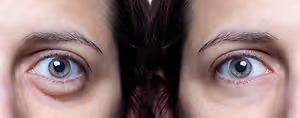
A concussion or whiplash injury can affect how your eyes and brain coordinate visual information, even when your eyesight remains clear. These changes may contribute to blurred vision, headaches, dizziness, light sensitivity, and difficulty reading or concentrating.
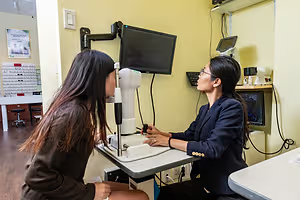
At Warden Optometry in Markham, we assess functional vision difficulties following head and neck injuries. Our neuro-optometric evaluations examine eye coordination, focusing, tracking, and other visual functions to identify problems that may benefit from targeted rehabilitation.
If visual symptoms are interfering with your recovery, our team can help determine whether neuro-optometric care is appropriate for you.


How Whiplash & Concussion Affect Your Visual System
Your visual system is closely tied to how your brain processes movement, balance, and spatial awareness.
Even a mild injury can disrupt:
- Eye coordination and alignment
- Focusing ability over time
- Eye tracking and depth perception
- How your brain processes visual input
- Your sense of balance and orientation
When these systems are disrupted, even simple tasks can start to feel harder than they should.
In many cases, symptoms appear days or weeks later, or only become noticeable when you return to work, screens, or daily routines.
Common Visual Symptoms After a Head Injury
Post-injury visual symptoms are often subtle at first but become more noticeable over time.
You may notice:
- Blurred or unstable vision
- Difficulty focusing or reading
- Light sensitivity
- Headaches, especially with visual tasks
- Dizziness or motion sensitivity
- Double vision and difficulty judging distances
- Trouble concentrating or mental fatigue
- Difficulty in busy or visually complex environments
Many patients describe it as feeling “not quite right,” even when standard tests are normal. These symptoms often become more noticeable when you try to return to normal routines.

How Neuro-Optometric Rehabilitation Helps
Neuro-optometric rehabilitation addresses specific visual difficulties that may develop following a concussion or whiplash injury. Depending on the examination findings, treatment may focus on eye coordination, tracking, focusing endurance, or sensitivity to visual motion.
At Warden Optometry and Neuro Vision, rehabilitation, recommendations are based on each patient's symptoms, visual function, and recovery goals. Treatment may involve structured vision therapy, prescribed lenses, or other approaches when clinically appropriate.
The goal is to improve identified visual difficulties and help patients manage activities such as reading, computer work, and movement more comfortably.
What to Expect During a Neuro-Optometric Evaluation
Your evaluation begins with a review of your injury history, current symptoms, and the activities that cause visual discomfort.
Depending on your needs, testing may assess:
-
Eye alignment and coordination
-
Eye tracking and movement
-
Focusing ability and endurance
-
Depth perception
-
Responses to visual motion
-
Other aspects of functional vision
Following the assessment, your optometrist will explain the findings and discuss whether targeted vision rehabilitation, prescribed lenses, or additional medical evaluation may be appropriate.
Learn more about our concussion treatment options, including prism lenses, vision therapy, and patient success stories.
Request a Concussion Vision Assessment in Markham
If your recovery feels incomplete, or if symptoms are still affecting your ability to work, read, or move comfortably, it’s worth understanding why.
The right diagnosis can change the direction of your recovery.
A vision health evaluation at Warden Optometry and Neuro Vision can help you move forward with more clarity and confidence.
Whiplash & Concussion FAQ
Yes. Many post-concussion issues involve how your eyes function, not just how clearly you see. You can have 20/20 vision and still struggle with coordination, focus, or visual processing.
Some symptoms only appear when your visual system is under demand, such as during reading, screen use, or movement. That’s why they may not be obvious right away.
Recovery timelines vary. Some patients improve within weeks, while others follow a longer program over several months.
That is often the goal. Rehabilitation focuses on improving the visual skills needed for real-world tasks like screen use, reading, and navigating busy environments.